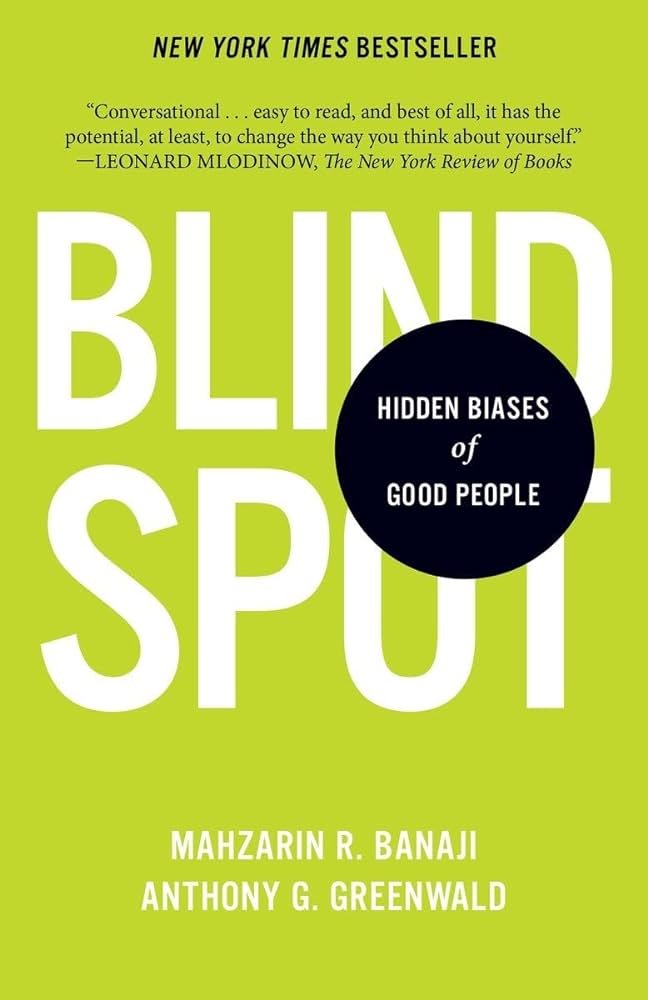
Blindspot: Hidden Biases of Good People
by Mahzarin R. Banaji and Anthony G. Greenwald
About the Authors
Mahzarin Banaji and Anthony Greenwald are well-known psychologists who have made major contributions to the study of social psychology, unconscious thinking, and implicit biases. Together, they helped create the Implicit Association Test (IAT), an instrument designed to measure automatic attitudes and beliefs.
Dr. Banaji teaches and conducts research at Harvard University, focusing on how thoughts and feelings develop within social settings and how shared beliefs shape social attitudes. Dr. Greenwald is a professor at the University of Washington whose work centers on unconscious cognition and subliminal perception. Through their research, both authors have shaped how scientists understand the unconscious habits of the human mind.
What Is This Book About?
Blindspot uses the idea of a “blind spot” as a central picture for the hidden preferences, biases, and prejudices that people carry without realizing it. These automatic reactions most often shape how individuals perceive differences in age, gender, race, ethnicity, religion, social class, sexuality, physical ability, and nationality. The authors set out to show that these biases are widespread—even among well-intentioned people—and to explain why the human brain develops them in the first place.
Drawing on decades of social psychology research and findings from the Implicit Association Test, the book explains how the brain naturally organizes information through quick shortcuts and mental categories. Banaji and Greenwald show that while these automatic habits help people make quick sense of the world, they also lead to unintended disparities between conscious values and everyday decisions. The text aims to make this research accessible, helping readers understand how these mental habits work and exploring ways to outsmart the automatic patterns of the mind.
Who Might Benefit from This Book?
This book serves as an accessible introduction for readers, students, and clients who are curious about social justice, prejudice, and how unconscious thinking works. It is especially useful for well-meaning individuals who want to understand the gap between their conscious values and their automatic reactions, as well as those seeking a clear look at how the human mind relies on shortcuts to make sense of everyday life.
The book is also an informative starting point for counselors, educators, and community leaders who want to introduce discussions about prejudice without using overly academic or combative language. However, readers looking for concrete, step-by-step strategies or practical counseling interventions to eliminate bias will need to look elsewhere, as the book focuses far more on identifying biases than on providing exercises to change them.
Key Ideas to Explore
Mindbugs
The authors use the term “mindbugs” to describe automatic brain habits that lead to errors in perception, memory, and judgment. Just as visual illusions trick the eyes into misjudging lines or colors, cognitive mindbugs cause the brain to fill in missing information automatically in order to make sense of an experience. These natural shortcuts help organize reality, but they can also cause people to remember things that never happened and draw faulty conclusions about other individuals.
Implicit Bias
A central theme of the text is that biases can operate completely outside of conscious awareness. Using the Implicit Association Test, the authors demonstrate how the brain forms automatic connections between specific groups of people and particular traits. Even people who genuinely believe in fairness and equality can harbor automatic preferences and negative associations that silently influence their reactions.
The Implicit Association Test (IAT)
The IAT is a computer-based sorting task that measures the speed with which a person pairs concepts—such as young versus old, or light skin versus dark skin—with positive or negative words. Faster reaction times reveal stronger automatic associations in the mind. The authors use different versions of this test to measure automatic attitudes regarding race, gender, age, religion, sexual orientation, disability status, and social class.
Stereotypes and Categorization
The brain naturally groups unfamiliar people into categories based on visible identifiers such as age, gender, race, and occupation. While categorization is a universal and practical function of human memory, it easily turns into stereotyping. When general assumptions are applied to individuals, they create inaccurate expectations and unfair judgments that fail to reflect who a person truly is.
What I Appreciated About the Book
The book’s explanation of mindbugs provides a helpful and eye-opening look at how the brain processes information. The visual examples and cognitive tasks clearly demonstrate how the mind automatically fills in missing details to create a sense of order. Showing that human memory can reliably create false details based on available cues helps readers see that their perceptions are not always accurate reflections of reality.
The discussion of how implicit biases affect members of stigmatized groups is another compelling observation. Banaji and Greenwald point to research showing that even individuals who actively advocate for marginalized groups often show automatic biases against their own group on the IAT. This finding highlights how deeply cultural messages can be absorbed, demonstrating that automatic associations are shaped by the surrounding environment rather than conscious intent alone.
The authors also offer a grounded perspective by balancing unconscious thinking with conscious reflection. While automatic associations exert a powerful pull on feelings and snap judgments, the reflective side of the brain allows people to pause, evaluate their thoughts, and make choices that match their actual values. Pointing to strategies such as regular exposure to counterstereotypical role models shows that automatic mental habits are not completely permanent.
Finally, the book concludes with a balanced and realistic call to action. Rather than claiming that biases can be entirely wiped out, the authors encourage readers to accept the limits of human perception and work deliberately to outsmart their natural blind spots. Acknowledging that the mind can deceive itself is an important step toward viewing others with greater honesty and fairness.
Things to Keep in Mind
Questions Regarding the Reliability of the IAT
The authors rely heavily on the Implicit Association Test throughout the book to support their core arguments. While the test is thought-provoking, the text spends little time addressing its practical limitations, test-retest reliability, or the ongoing debates regarding its predictive validity. At times, the constant presentation of the test feels like a promotional effort on behalf of the authors’ own tool, leaving questions about how well individual test scores translate into actual real-world behavior.
The Inevitability of Bias from Categories
Banaji and Greenwald suggest that because the brain automatically sorts people into categories, these stereotypes inevitably produce bias against specific groups. However, this conclusion feels overly presumptive. When a person lacks personal experience with a particular group, they may simply rely on whatever external information they have received without necessarily holding personal hostility or deep-seated prejudice toward that group. Stating that mental categorization automatically leads to active bias assumes a connection that does not always match individual reality.
Equating Practical Favors with Discrimination
In Chapter 7, the authors share the story of a university professor who received higher-level medical attention for an injured hand after an emergency room team recognized her status. The authors present this story as an example of in-group favoritism and hidden discrimination. However, using this situation as an illustration of bias overlooks practical reality. Calling in a specialized specialist for a particular patient is often a matter of practical professional discretion or a personal favor rather than intentional discrimination against others. In any hospital setting, resources and favors are limited, and not every case can involve the chief of surgery. Framing this practical dynamic strictly as discrimination stretches the definition of bias in a way that feels unconvincing.
Lack of Concrete Action Steps
While the book is effective at identifying hidden biases, it offers very little in the way of practical, day-to-day strategies for overcoming them. Readers hoping for concrete exercises, counseling tools, or behavioral interventions to help change automatic thinking patterns will find the practical takeaways rather thin.
Why This Book May Be Helpful in Counseling
Blindspot provides counselors, educators, and clients with a helpful, research-based framework for understanding how unconscious attitudes develop. Because the authors explain brain shortcuts using accessible metaphors rather than dense clinical jargon, the material helps lower defensiveness when discussing sensitive topics like prejudice, social attitudes, and systemic assumptions.
For clients exploring personal values, relational habits, or social attitudes, the book offers a validating look at the gap between good intentions and automatic thoughts. It normalizes the fact that all people have mental blind spots, which can help clients approach their own hidden assumptions with curiosity rather than shame. At the same time, clinicians should treat the book primarily as an educational introduction to unconscious thinking, pairing it with other resources when clients need practical steps for behavioral change.
Questions for Reflection
- In what ways have personal assumptions or mental shortcuts led to misjudging an individual before getting to know them?
- When taking an association test or noticing a snap reaction, what feelings surface when automatic thoughts conflict with conscious values?
- How have cultural messages, media representations, and early environments shaped initial reactions to different groups of people?
- In what areas of life might personal blind spots lead to treating people differently without realizing it?
- What is the difference between an automatic thought that pops into the mind and an intentional belief that guides daily choices?
- What practical habits, such as seeking out diverse perspectives or slowing down important decisions, can help prevent snap judgments?
A Final Thought
Recognizing that the human mind has natural blind spots is not an admission of moral failure; it is an honest acknowledgment of how the brain works. While automatic associations can easily lead to inaccurate judgments, learning to question quick assumptions and look past simple categories allows people to see others as they truly are.
Book Information
Title: Blindspot: Hidden Biases of Good People
Authors: Mahzarin R. Banaji and Anthony G. Greenwald
Publisher: Bantam Books
Publication year: 2013
APA Reference
Banaji, M. R., & Greenwald, A. G. (2013). Blindspot: Hidden biases of good people. Bantam Books.