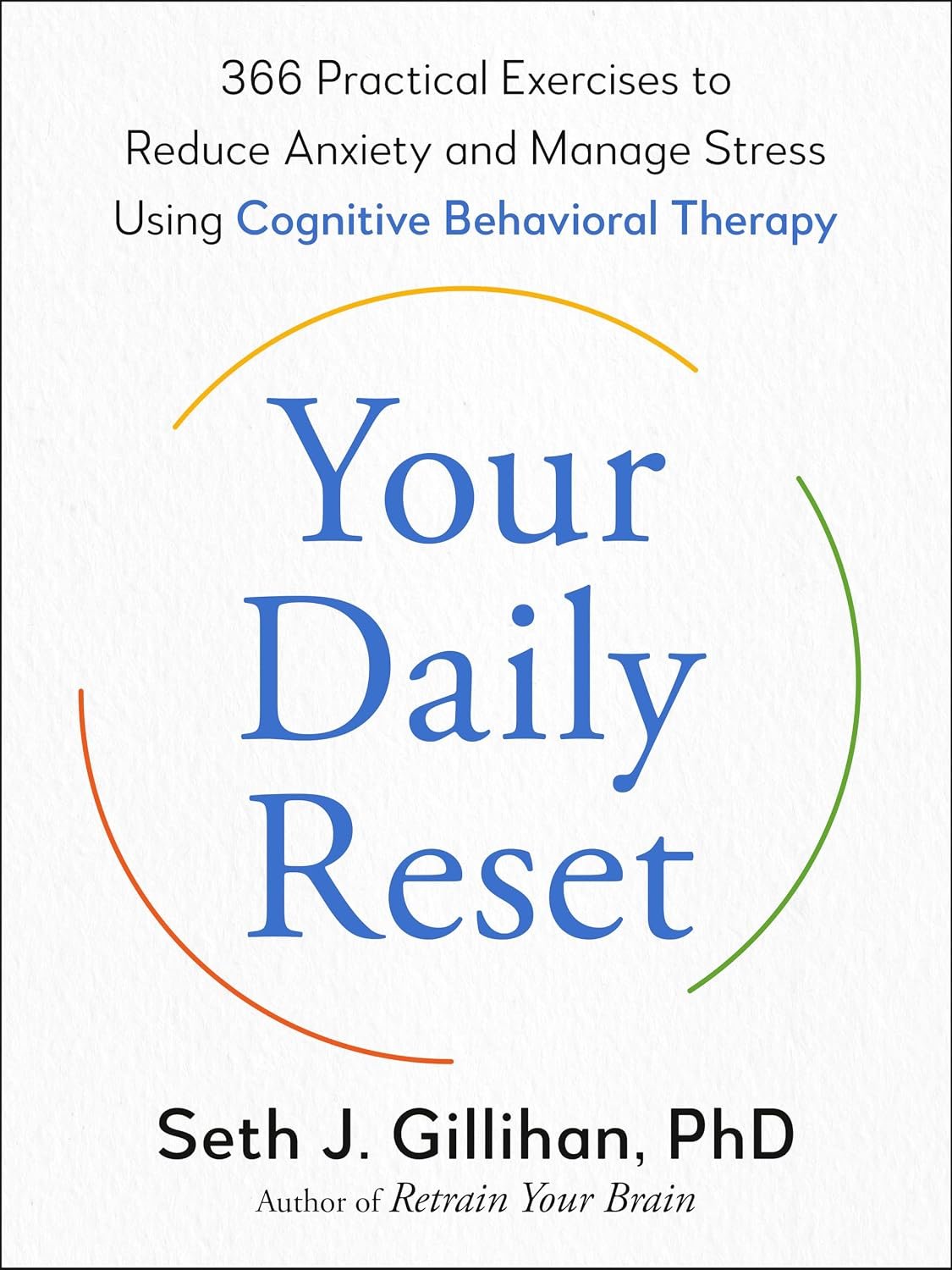
Your Daily Reset: 366 Practical Ways to Reduce Stress and Anxiety
by Seth J. Gillihan, Ph.D.
About the Author
Seth J. Gillihan, Ph.D., is a licensed psychologist who specializes in mindful cognitive behavioral therapy (CBT). His clinical work and writing focus on providing practical tools to help people manage everyday stress, anxiety, depression, burnout, sleep problems, and major life transitions. He previously served on the faculty at the University of Pennsylvania School of Medicine and now runs a private practice. He has written several books centered on the practical use of CBT and mindfulness.
What Is This Book About?
Your Daily Reset gives readers 366 short exercises to help them handle stress and worry each day. Rather than claiming that anxiety can be cured forever, Gillihan explains that feeling nervous or stressed is a normal part of being human. The main goal of the book is to teach people how to respond to worry with patience, clear thinking, and simple actions.
The book brings together three core tools: staying aware of the present moment, checking unhelpful thoughts, and taking small, positive steps. Each day offers a quick task, such as a question to think about, an easy breathing step, or a tiny challenge. Readers learn that thoughts are not always facts, that accepting hard times is not the same as giving up, and that real progress comes from small daily habits.
Who Might Benefit from This Book?
This book is written for anyone who wants quick, simple tools they can use during a busy day. It is especially helpful for:
- People who feel overwhelmed by thick self-help books and want short, easy readings.
- Anyone dealing with daily worry, job stress, burnout, or big life changes who needs a quick daily reset.
- People who are hard on themselves and think that feeling anxious means they have failed.
- Readers who want to catch thinking traps—like assuming the worst or trying to read other people’s minds—without reading a textbook.
- People already in counseling who want simple exercises to practice between weekly visits.
Key Ideas to Explore
Anxiety Is a Normal Part of Life
Gillihan challenges the idea that healthy people should never feel anxious. He explains that worry is a normal human feeling, not proof that someone has failed. Readers are encouraged to stop beating themselves up and learn to treat uncomfortable feelings with patience.
Thoughts Are Interpretations, Not Facts
The book shows that our minds often jump to conclusions that make stress worse, such as assuming the worst about the future, overgeneralizing, or trying to guess what others are thinking. Gillihan teaches readers to treat their thoughts as ideas to test rather than absolute truths, examining the real evidence before believing their automatic assumptions.
Acceptance Paired with Action
Gillihan makes a clear distinction between accepting reality and simply giving up. True acceptance means acknowledging difficult emotions and circumstances as they are, rather than waiting for all discomfort to vanish before taking the next step. Readers are encouraged to continue pursuing what matters to them even while feeling uneasy.
Bringing Attention Back to Today
Anxiety (or worry) frequently pulls our attention forward into imagined disasters, while regret pulls it backward into past mistakes. The author provides short sensory checks, physical grounding techniques, and simple breathing exercises to help readers pull their minds out of mental loops and bring them back to the present moment.
Small Steps Build Real Progress
The book does not ask readers to change their entire lives overnight. Instead, it shows that lasting change develops through tiny, repeated actions. Practicing small behaviors—like questioning a critical thought, taking a short walk, finishing an avoided task, or taking time to rest—builds confidence through steady practice over perfection.
What I Appreciated About the Book
The daily format makes the ideas very easy to use. Because each entry takes only a couple of minutes to read, readers can easily fit the practices into their daily routines without feeling burdened.
The short monthly introductions give just enough background without burying the reader in theory. Starting each month with a quick look at a main theme—such as letting go of stories, showing self-kindness, or handling the unknown—sets up the daily pages nicely.
Gillihan does a wonderful job mixing mindfulness, clear thinking, and real action. The book does not stop at simple breathing tricks. By asking readers to catch bad thinking habits, change their self-talk, and face tasks they have avoided, the book offers a well-rounded set of tools.
The book also encourages readers to be flexible. Rather than forcing people to follow every day in order, Gillihan encourages readers to bookmark their favorite pages, take pictures of helpful exercises, and build a personal toolbox that works for them.
Finally, the appendix provides a simple, useful guide to common thinking traps. Listing everyday examples of habits like catastrophizing, mind-reading, and all-or-nothing thinking gives readers an easy reference to spot unfair thoughts in real life.
Things to Keep in Mind
Not Enough for Severe Anxiety
The book’s short daily exercises are great for general stress, but they cannot take the place of professional care. People dealing with deep trauma or severe anxiety disorders will still need one-on-one help from a trained doctor or counselor.
Explanations are Brief
Gillihan purposely keeps his explanations short so the book stays practical and fast. Readers who want deep, detailed explanations of psychology research or the science behind mindfulness will need to look to larger textbooks.
Why This Book May Be Helpful in Counseling
Your Daily Reset works well as a practical workbook for therapists to use with clients. Because each page is short and clear, counselors can easily assign specific entries between sessions to help clients practice mindfulness, notice their self-talk, and take small steps forward.
The flexible layout makes it easy to match pages to what a client needs right then. A counselor helping someone with negative thoughts can use the spring entries, while someone working on facing fears can use the summer entries. The daily pages give clients a simple way to practice their skills without getting bogged down by heavy reading.
Questions for Reflection
As you read, consider the following questions:
- When you start to feel stressed, do you treat worry as a personal flaw or as a normal human reaction?
- Which common thinking trap—like assuming the worst or guessing what others think—shows up most in your life?
- What is one small, helpful step you have been putting off until you feel completely calm or confident?
- How does taking a slow, deep breath or noticing the room around you help stop racing thoughts?
- What does the difference between truly accepting a hard situation and just giving up look like to you?
- Which daily habits bring the most real peace and calm to your mind?
You do not have to answer every question at once. Choose the ones that feel most useful to you.
A Final Thought
Peace of mind rarely comes from waiting for all of life’s problems to disappear. Real growth happens when we learn to meet hard feelings with patience, check our thoughts against the facts, and take the next small step forward each day.
Book Information
Title: Your Daily Reset: 366 Practical Ways to Reduce Stress and Anxiety
Author: Seth J. Gillihan, Ph.D.
Publisher: TarcherPerigee
Publication year: 2025
APA Reference
Gillihan, S. J. (2025). Your daily reset: 366 practical ways to reduce stress and anxiety. TarcherPerigee.