by Peter Scazzero
Book Review #10
Scazzero, P. (2017). Emotionally healthy spirituality: It’s impossible to be spiritually mature while remaining emotionally immature (Updated ed.). Zondervan.
Peter Scazzero is the former senior pastor of New Life Fellowship Church in Queens, New York, who, after experiencing both personal and professional burnout in ministry, recognized the limitations of traditional discipleship models. In response to this, he developed a ministry that emphasized integrating emotional health with spiritual formation and co-founded Emotionally Healthy Discipleship. His work has influenced churches and Christian leaders worldwide.
Purpose and Audience:
Emotionally Healthy Spirituality is written primarily for Christians, pastors, ministry leaders, and churches seeking deeper spiritual transformation. Scazzero outlines the top ten symptoms of emotionally unhealthy spirituality and argues that genuine spiritual transformation cannot occur without emotional maturity. Throughout the book, he challenges readers to confront unhealthy relational patterns, unresolved family issues, and neglected emotional wounds while cultivating a more introspective relationship with Christ. His goal is to help believers experience lasting transformation that affects every area of life rather than merely increasing biblical knowledge or ministry involvement.
Identification of key themes or ideas:
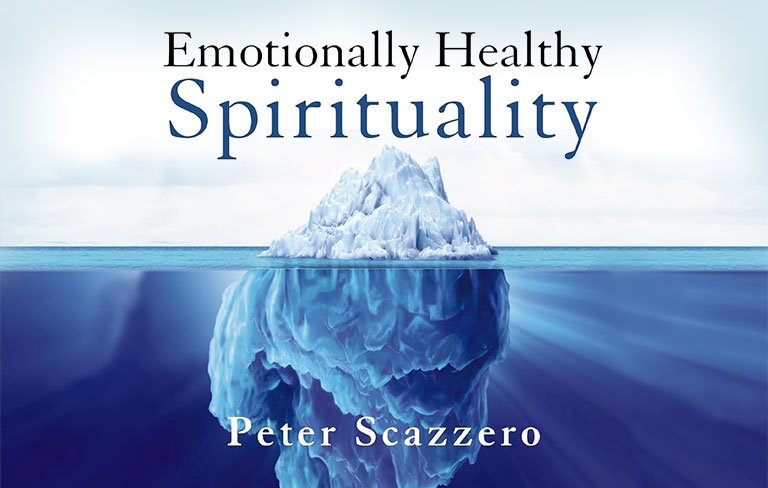
- Emotionally Healthy Spirituality: Transformation Below the Surface (Chapter 1). Scazzero’s central thesis is that God’s desire is not simply to change outward behavior but to transform the whole person. Many Christians allow Christ access only to the visible “10 percent” of their lives while the hidden “90 percent,” including wounds, fears, motives, family-of-origin patterns, and emotional immaturity, remains largely untouched. Genuine spiritual maturity requires giving Christ access to the entire iceberg, not merely what others can see.
- Knowing God requires honestly knowing oneself (Chapter 2). Scazzero repeatedly argues that believers cannot grow in intimacy with God while remaining disconnected from their own emotional experience. They must learn to recognize and honestly engage their emotions, thoughts, desires, motivations, fears, wounds, limitations, and personal history. Spiritual growth requires rejecting false identities built upon performance, possessions, popularity, or the expectations of others. Through differentiation, believers learn to embrace their authentic selves in Christ while maintaining healthy boundaries in relationships.
- Going Back to Go Forward (Chapter 3). Lasting transformation requires understanding the influence of one’s family of origin. Family commandments, generational patterns, unresolved wounds, and cultural expectations continue shaping relationships until they are brought into the light. Tools such as genograms help believers recognize these patterns so they can experience genuine freedom in Christ.
- Spiritual growth often occurs through surrender rather than achievement (Chapters 4–5). Scazzero describes experiences such as “the Wall,” grief, loss, and personal limitations as essential components of spiritual formation rather than interruptions to it. These seasons expose self-reliance, challenge false expectations of God, and invite deeper trust. Instead of striving to accomplish more, believers mature as they surrender control, embrace dependence on God, and remain faithful through suffering.
- Rhythms of the Daily Office and Sabbath (Chapter 6). Scazzero emphasizes that believers must intentionally slow down to cultivate a life of communion with God. The Daily Office and Sabbath shift the focus from constantly doing for God to simply being with God, creating space for prayer, rest, worship, and attentive listening.
- Rule of Life (Chapter 8). Spiritual growth is sustained through intentional rhythms rather than good intentions alone. Scazzero encourages believers to develop a personal Rule of Life that provides practical structures for prayer, rest, relationships, work, and recreation, helping them remain rooted in Christ throughout every season of life.
Points of interest and points of personal agreement and disagreement
Points of interest:
- The iceberg illustration (Chapter 1). Scazzero’s analogy that much of a person’s spiritual life exists beneath the surface was particularly compelling. It provided a helpful picture of how believers can appear spiritually mature through visible disciplines while unresolved emotional wounds and relational patterns continue to influence everyday life.
- Family-of-origin work (Chapter 3). I found Scazzero’s emphasis on understanding one’s family system especially interesting because it closely parallels concepts found in Bowen Family Systems Theory. His argument that conversion does not automatically erase learned relational patterns provides an important bridge between biblical discipleship and counseling.
- “The Wall” as a normal part of spiritual growth (Chapter 4). Rather than viewing seasons of suffering, doubt, or spiritual dryness as signs of failure, Scazzero presents them as expected stages in spiritual formation. This reframing offers hope for believers who feel as though God has become distant during difficult seasons.
- Enlarge Your Soul Through Grief and Loss (Chapter 5). Rather than avoiding pain, Scazzero argues that grieving is an essential part of spiritual maturity. Christians must learn to acknowledge and process emotions such as anger, sadness, fear, disappointment, waiting, and even depression before God. Grief enlarges the soul because it teaches surrender, dependence, and trust in God’s presence amid suffering.
Points I agreed with:
- Spiritual activity can become a means of avoiding spiritual transformation (Chapter 1). Scazzero’s observation that believers sometimes use ministry, Bible study, prayer, or service to avoid confronting unresolved emotional issues was one of the most thought-provoking ideas in the book. It challenged the assumption that increased religious activity always reflects increased spiritual maturity.
- Emotions/feelings are part of the human experience (Chapter 2). One of Scazzero’s most significant arguments is that emotions are not obstacles to spirituality but an essential part of being created in God’s image. Because human beings are integrated persons—consisting of heart, mind, soul, and strength—ignoring emotions diminishes our humanity. Learning to recognize anger, sadness, fear, grief, and joy enables believers to encounter God honestly rather than hiding behind religious performance. Emotional awareness becomes a pathway to deeper intimacy with God rather than a distraction from it.
- Family systems continue shaping believers long after conversion (Chapter 3). The connection Scazzero makes between family-of-origin patterns and present-day relationships was particularly interesting because it closely parallels concepts found in family systems theory while remaining grounded in a biblical understanding of sanctification.
- The “Wall” should be expected rather than feared (Chapter 4). Viewing seasons of suffering, disappointment, and spiritual dryness as a normal part of Christian growth reframes difficult experiences as opportunities for deeper dependence upon God instead of evidence of spiritual failure.
- Healthy limits are expressions of faith rather than selfishness (Chapters 5–6). Scazzero’s discussion of grief, Sabbath, and personal limitations challenged the assumption that faithfulness is measured primarily by productivity or constant availability to others.
- Being with God must precede doing for God (Chapter 6). Ministry should flow from intimacy with Christ rather than from performance, obligation, or the desire for approval. This principle serves as an important safeguard against burnout and misplaced identity.
- Healthy relationships are one of the clearest pieces of evidence of spiritual maturity (Chapter 7). Spiritual and emotional maturity are demonstrated in relationships. Because of this, people are not to be treated as objects or problems to be solved, but rather to be respected for their dignity. The book encourages believers to engage in conflict honestly, clarify expectations, stop mind-reading, recognize emotional triggers and “allergies,” and respect the relational “Bill of Rights” as practical expressions of Christlike love.
Points of disagreement:
There wasn’t anything major that I really “disagreed with” in the book. There were a few things I had a differing opinion on.
- Differentiation (Chapter 2). I appreciated Scazzero’s application of differentiation to the Christian life, particularly his emphasis on resisting the pressure to find identity in others’ expectations. However, I questioned whether Bowen’s theory was the best conceptual framework for this discussion. While differentiation helps explain relational functioning, I believe an attachment-based framework or another developmental model may have better reflected the transformational process Scazzero describes throughout the book, especially the ongoing work of God in healing wounded relationships and shaping identity in Christ.
- Journey Through the Wall (Chapter 4). I appreciated Scazzero’s emphasis that God often uses seasons of suffering, disappointment, and uncertainty to produce spiritual growth. However, I found his conceptualization of “the Wall” (notice its capitalization) somewhat inconsistent. Drawing from The Critical Journey and the tradition of “the Dark Night of the Soul,” Scazzero presents the Wall as a distinct stage of spiritual formation throughout the chapter. Yet he also explains that believers frequently encounter multiple “walls” throughout their lives. While I understood the spiritual reality he intended to describe, I found the metaphor somewhat strained.
Significance of the book to the counseling field:
Emotionally Healthy Spirituality makes a meaningful contribution to the counseling field by highlighting the inseparable relationship between emotional, relational, and spiritual health. Scazzero encourages readers to examine family-of-origin influences, unresolved grief, emotional awareness, healthy boundaries, and authentic relationships—areas that are central to effective counseling. His work also challenges Christian counselors and ministry leaders to recognize that biblical knowledge and spiritual activity alone do not necessarily produce emotional maturity or lasting transformation.
Critique of the overall work:
Overall, I found Emotionally Healthy Spirituality to be an insightful and practical resource that challenges many assumptions about Christian discipleship. Scazzero effectively combines biblical teaching, personal transparency, and practical application to demonstrate the importance of emotional health in spiritual formation. Although I questioned portions of his conceptual framework, such as his use of differentiation and the metaphor of “the Wall,” those concerns did not diminish the book’s overall value. It is a thought-provoking work that encourages believers to pursue deeper transformation rather than settling for outward religious performance.
Usefulness of the book for potential clients
I would recommend this book for Christian clients who desire greater spiritual and emotional maturity, particularly those struggling with burnout, people-pleasing, unresolved family-of-origin issues, grief, perfectionism, or unhealthy relationship patterns. It would also be a valuable resource for pastors, ministry leaders, and mature believers who recognize a disconnect between their outward faith and their inner lives. While I would not assign it to every client, I believe it could serve as an excellent bibliotherapy resource when paired with counseling that helps clients thoughtfully process its concepts and apply them within a sound biblical framework.



Leave a Reply