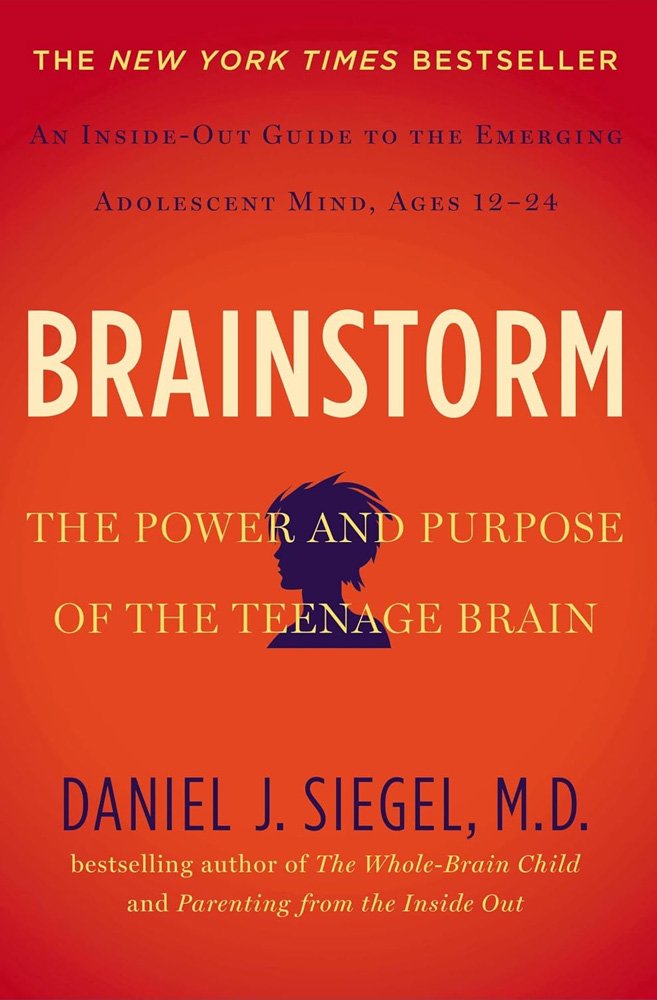
by Daniel Siegel
Book Review #9
Siegel, D. J. (2013). Brainstorm: The power and purpose of the teenage brain. Tarcher/Penguin.
Daniel J. Siegel, M.D., is a professor of psychiatry at the UCLA School of Medicine and founder of the Mindsight Institute. He is an internationally recognized author in the field of interpersonal neurobiology. His work integrates neuroscience, psychology, attachment theory, and mindfulness to explain human development and promote mental health. Siegel has written numerous books for clinicians, parents, educators, and the general public.
Purpose and Audience:
Brainstorm is written for adolescents, parents, educators, counselors, and other adults who work with teenagers. Rather than portraying adolescence as a developmental problem to survive, Siegel argues that it is a unique period of opportunity characterized by increased emotional intensity, social engagement, novelty seeking, and creative exploration. He combines current neuroscience, personal stories, attachment theory, and practical exercises to help readers better understand the teenage brain while promoting healthier relationships, stronger communication, and lifelong emotional integration.
NOTE: Brainstorm is not organized into classic chapters, like most books; instead, it is arranged in parts and has various section headings. Because the eBook version of the book was used, page numbers may fluctuate depending on device and display settings. As such, references correspond to the relevant “chapter headings” or section titles.
Identification of key themes or ideas:
- ESSENCE as the Framework for Understanding Adolescence – Siegel organizes the entire book around the ESSENCE framework: Emotional Spark (ES), Social Engagement (SE), Novelty (N), and Creative Explorations (CE). He argues these four characteristics explain both the strengths and challenges of the adolescent brain and should be cultivated throughout adulthood.
- Mindsight and Seeing the “Sea Inside” – A major emphasis throughout the book is developing mindsight: learning to recognize one’s own internal experience and the internal experience of others. Practical exercises such as SIFT, the Wheel of Awareness, and empathy practices are intended to strengthen this ability.
- Integration as the Goal of Healthy Development – Healthy growth occurs through linking differentiated parts into integrated wholes. Integration occurs both within the brain and between people in relationships, while chaos and rigidity represent two extremes of impaired integration.
- Brain Development Shapes Behavior – Siegel explains how dopamine, remodeling, pruning, executive functioning, and reward sensitivity contribute to adolescent behavior. Understanding these changes helps parents, counselors, and adolescents respond with greater wisdom rather than simply labeling teenagers as immature.
- Attachment and Relationships – The quality of early attachment relationships influences emotional development throughout life. However, Siegel emphasizes that secure attachment can continue to develop through reflection, healthy relationships, and intentional repair of relational ruptures.
Points of interest and points of personal agreement and disagreement
Points of interest:
- I appreciated that Siegel begins the book by recognizing that readers learn differently. Rather than insisting the book be read sequentially, he suggests several ways readers can approach the material depending on whether they prefer stories, practical exercises, or scientific explanation. (The Benefits and Challenges of Adolescence)
- The SIFT exercise (Sensations, Images, Feelings, Thoughts) stood out as a useful strategy for increasing awareness of one’s internal experience. It is simple enough to teach clients while still reflecting deeper concepts of emotional regulation and self-awareness. (Mindsight Practice A: Insight and SIFTing the Mind)
- Siegel’s concept of “Seeing Inside the Sea Inside” was particularly interesting. He uses the “sea inside” as a metaphor for the constantly changing inner world of the mind—our sensations, images, feelings, thoughts, memories, desires, and other mental experiences. Learning to notice this inner world is central to the development of mindsight. He returns to it several times throughout the book, connecting it to SIFT, empathy, integration, and other mindsight practices. (Seeing Inside the Sea Inside)
- Interestingly, Siegel suggested watching television with subtitles while intentionally imagining what each character may be thinking, feeling, or experiencing based only on tone of voice, facial expressions, and body language. Doing so would help develop greater empathy and attunement by intentionally practicing the ability to perceive another person’s inner world. He emphasized that accuracy was less important than practicing the habit of trying to understand another person’s inner world. (Mindsight Practice C: Empathy)
- He reiterates the importance of integration occurring both within us and between us. This highlights the fact that healthy development involves not only integrating the different aspects of our own minds and brains but also developing integrated, connected relationships with others. (Integration; Sensing the Harmony of Integration)
- The discussion of chaos and rigidity as two opposite expressions of disintegration provided a helpful framework for understanding many emotional and behavioral struggles encountered personally and professionally. (When Integration Is Not Present: Chaos or Rigidity)
- I appreciated Siegel’s reminder to approach people with Curiosity, Openness, Acceptance, and Love (COAL). Throughout the book, this posture encourages parents, counselors, and individuals to seek understanding before judgment and creates space for empathy and healthy communication.
Points I agreed with:
- I agreed with Siegel’s core premise that we should not view adolescence as a developmental problem to merely survive. Instead, the emotional intensity, growing importance of peers and relationships, drive toward new experiences, and openness to new ways of thinking are developmental qualities that can continue to benefit us throughout adulthood. This emphasis on courage, creativity, curiosity, and growth provides a refreshing and hopeful perspective for both parents and professionals. (The Benefits and Challenges of Adolescence)
- I appreciated Siegel’s emphasis on integration and his description of growth as involving both differentiation and linkage. I found his distinction between integration within us and integration between us particularly meaningful. His discussion of chaos and rigidity as states that can emerge when integration is impaired also provides a useful framework for understanding emotional and relational difficulties. (Integration; When Integration Is Not Present: Chaos or Rigidity)
- I appreciated the practical emphasis on developing mindsight through intentional reflection. Exercises such as SIFT, reflective conversations, and the Wheel of Awareness provide concrete ways for individuals to develop greater self-awareness, emotional regulation, and empathy. These are skills that can benefit clients across a wide range of presenting concerns. (Insight and SIFTing the Mind; The Wheel of Awareness; Reflective Conversations)
- I was intrigued by Siegel’s explanation of adolescent brain remodeling. It helped me better understand why significant changes in thinking and behavior occur during this period of development. I found his discussion of pruning, myelination, integration, and the development of gist thinking particularly useful. The idea that these neurological changes can affect judgment, emotional regulation, and decision-making provides important context for understanding adolescent behavior. (Integrating Your Brain; The Remodeling Brain and Flipping Our Lids; Adolescence Builds Integration in the Brain)
- I also appreciated the reminder that relationships continue to shape development throughout life. Siegel’s emphasis on attunement, maintaining connection, and repairing relational ruptures provides a helpful perspective on navigating the inevitable challenges that occur within relationships. (Repairing Ruptures; Creating a Safe Harbor and Launching Pad for Adolescents)
Points of disagreement:
- I disagreed with Siegel’s treatment of love, specifically, distilling it to three forms: sexual, romantic, and attachment love. While I recognize that each represents an important form of human connection, I think the framework leaves little room for the nuance that exists within relationships. For adolescents especially, I believe a broader understanding of love is important because affection, friendship, commitment, sacrifice, attraction, and attachment do not always fit neatly into these three categories. (Romance and First Love)
- Although I appreciated Siegel’s emphasis on demonstrating empathy and maintaining loving relationships, I disagreed with his discussion of sexual orientation because it assumes an open/affirming framework. He does this without acknowledging the fact that many readers will approach the subject from a Christian worldview. Instead, he characterizes any opposition to same-sex relationships as homophobia. This leaves little room for contrary beliefs, such as beliefs about biblically appropriate expressions of human sexuality. In my work, I’ve found that a person can experience same-sex attraction without that experience necessarily defining their sexual identity. (Acceptance, Letting Go of Expectations, and Sexual Orientation)
- Siegel encourages parents to have a plan in place if their teenager drinks alcohol or uses drugs. This may include letting them call for a ride home without fear of immediate punishment. While I understand his intent, I think this approach could be seen as normalizing (or even encouraging) underage drinking or drug use. I would have preferred him to make a clearer distinction between keeping a teenager safe in an emergency and accepting behaviors that many families consider legally and morally wrong. (Drug Use or Abuse?)
- Siegel occasionally presents certain relational or ethical conclusions as though they naturally follow from neuroscience. While brain science can help explain patterns of development and behavior, I do not believe it can, by itself, resolve moral or philosophical questions. In several places, the book moves from descriptive neuroscience to normative conclusions more quickly than I found convincing. (Throughout the book, especially Part IV)
Significance of the book to the counseling field:
By and large, Brainstorm makes a significant contribution to the counseling field by translating complex neuroscience into language that parents, counselors, educators, and adolescents can understand. Siegel connects brain development, attachment, emotional regulation, and relationships in practical ways that counselors can apply when working with adolescents and their families. The book also provides numerous experiential exercises that can be incorporated into counseling sessions to strengthen self-awareness, emotional regulation, empathy, and relational functioning.
Critique of the overall work:
Overall, I found Brainstorm to be an engaging and thought-provoking resource. Siegel successfully combines neuroscience, personal stories, practical applications, and attachment theory into a readable discussion of adolescent development. His writing style is conversational and accessible without sacrificing scientific credibility. The greatest strengths of the book are its hopeful view of adolescence, its practical exercises, and its acronyms. My primary concerns involve several philosophical and ethical conclusions—particularly regarding sexuality and substance use—which appear to reflect assumptions that not all readers, especially those from Christian worldviews, will share.
Usefulness of the book for potential clients
Overall, I would cautiously recommend Brainstorm. It could be particularly beneficial for parents of adolescents, teenagers seeking to better understand their own development, educators, youth workers, and counselors working with adolescent clients. The book provides accessible explanations of brain development along with practical exercises that promote self-awareness, emotional regulation, empathy, and healthier relationships.
While much of the neuroscience, attachment theory, and practical guidance is excellent, the sections addressing sexual orientation and substance use reflect ethical assumptions that may conflict with individuals who hold a biblical worldview. As such, it requires a disclaimer for any clients or parents who also hold Christian ideals.



Leave a Reply